


AI browser agents don’t just need a smart model behind them anymore — they need an IP address the internet actually trusts. In 2026, that single detail decides whether your agent completes a task or gets stuck behind a CAPTCHA wall. This guide breaks down the real difference between a residential IP VPS and a residential proxy, and which one actually keeps an AI browser agent running without interruption.
TL;DR
- This guide breaks down the real difference, when each one wins for AI browser agents, and what each setup actually costs at scale.
- AI browser agents — Claude’s Computer Use, Perplexity Comet, and (until OpenAI retired it as a standalone app on August 9, 2026) ChatGPT Atlas — all get CAPTCHA-walled or blocked instantly when they run from a datacenter IP.
- A residential proxy solves this for short, high-fanout jobs like scraping or SERP checks.
- A residential IP VPS solves it for persistent, session-based agents that need to stay logged in around the clock.
Why This Question Suddenly Matters
Two years ago, “residential proxy vs VPS” was a niche question for scrapers and ad-verification teams. In 2026 it’s a mainstream infrastructure decision, because the thing making the request from your server is no longer just a script — it’s an AI agent. AI-powered browsers have grown roughly 65% year-over-year as people replace stacks of browser extensions with native agentic automation, and the leading open-source browser-agent framework now completes about 89% of tasks on the WebVoyager benchmark. The broader agentic AI market was valued at $7.55 billion in 2025 and is projected to approach $200 billion by 2034.
That growth is concentrated in a handful of products: Perplexity Comet’s rollout now spans iOS, Android, macOS, Windows and iPad, OpenAI’s Atlas shipped Operator-style “Agent Mode,” and Anthropic’s Claude — following its February 2026 Vercept acquisition — pushed Claude Sonnet 4.6 to a 72.5% score on the OSWorld benchmark, close to the human performance ceiling on that test, while Operator trailed at 38.1%. Notably, OpenAI announced on July 9, 2026 that it would retire the standalone ChatGPT Atlas browser, with the app shutting down on August 9, 2026 and its agentic features folding into the ChatGPT desktop app and a Chrome extension instead — a reminder that this category is still moving fast enough to reshape itself month to month.
If you’re new to the underlying concept, our guide on what residential RDP actually is covers the fundamentals in more depth before you dive into this comparison.
What Is a Residential Proxy?
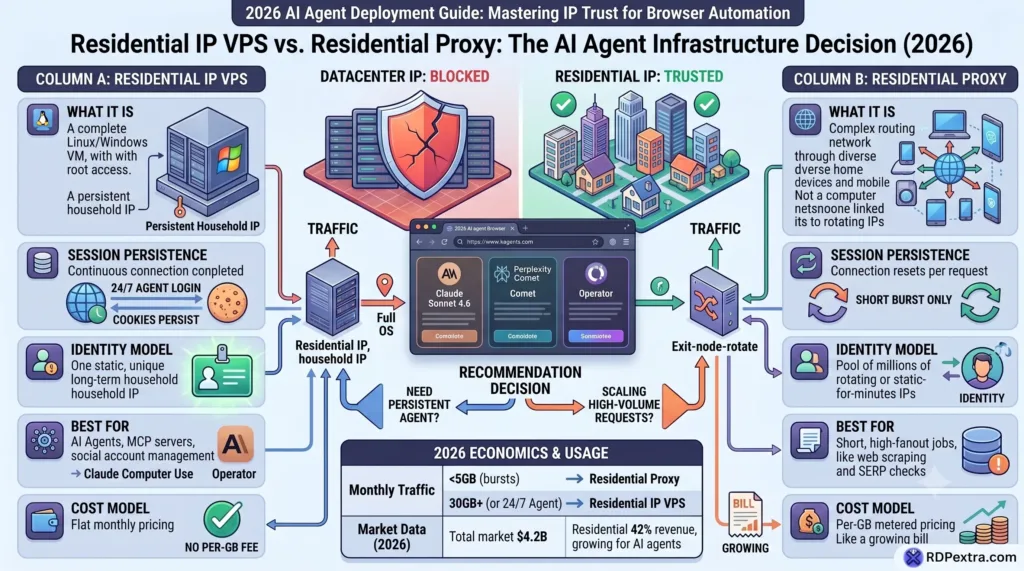
A residential proxy is a routing layer, not a computer. It uses an IP address that an internet service provider has assigned to a real household device — a router, a laptop, a phone — so a website sees a legitimate consumer IP instead of a server address. You send your traffic to a gateway, the gateway picks an exit node, and once the response comes back, the connection disappears — there’s no persistent operating system on the other end. Developers increasingly chain these proxies through a VPS specifically to keep a stable US or EU residential identity for automation tools that talk to social platforms and AI services, which tells you a lot about where demand is heading.
If you need a fixed IP without full rotation, a static ISP proxy sits in between — datacenter-level speed with a residential-trust IP, useful when you want consistency without running a full VPS.
What Is a Residential IP VPS?
A residential IP VPS, by contrast, is a full virtual machine — Linux or Windows — whose public IP is allocated to a consumer ISP rather than a hosting ASN. To the rest of the internet it looks like a home computer on a normal broadband line, except it runs in a hardened cloud environment with high uptime and full root access. It gives you a real ISP-issued address plus complete OS control, a 24/7 environment, sticky IP, and no per-gigabyte metering — the exact profile a long-running AI agent needs.
Why AI Browser Agents Specifically Need This
This isn’t a theoretical distinction anymore — it’s the reason agents fail in production.
How Bot Detection Scores Every Request
Cloudflare alone protects roughly a fifth of the internet, and its Bot Management product scores every request against ASN reputation, TLS fingerprints, behavioral signals, and a proprietary risk model, with datacenter proxies and low-trust residential IPs failing instantly. Cloudflare’s own documentation describes a Bot Score between 1 and 99 that estimates how confident the system is that a given request came from a bot, and datacenter ASNs from major cloud hosting providers get default-low trust, while residential ISP ASNs start at baseline trust unless they’re flagged. The gap in outcomes is stark: datacenter proxies achieve 60–90% success on unprotected sites but drop to just 20–40% on targets running layered bot-management systems, whereas residential proxies deliver 85–99% success on those same protected targets.
Why “Stack Drift” Catches Even More Bots
Detection has also gotten more layered. Modern anti-bot systems check IP reputation and ASN classification before a single byte of page content loads, and they increasingly look for “stack drift” — inconsistency between your TLS fingerprint, HTTP/2 behavior, and IP origin — rather than any single signal alone. This is exactly the failure mode agent builders are running into: one popular open-source agent framework, which passed 95,000 GitHub stars within seven weeks of its February 2026 release, quietly degrades or hard-fails on a flagged datacenter IP — CAPTCHAs, “suspicious login” blocks, scraping errors, and messaging-app number bans all show up the moment the host VPS uses a hosting ASN. Skill builders have reached the same conclusion from a different angle: an AI agent’s browser making requests from a typical cloud VPS gets flagged by the destination site as not-a-real-person, and no amount of user-agent spoofing or stealth plugin fixes it, because the IP address itself is the problem.
The Real-World Stakes Are Already Here
Even the newest agentic browsers aren’t immune from the wider consequences of automated browsing at scale — a January 2026 lawsuit challenging an AI browser’s automated shopping behavior was the first real legal test of agentic browsing on the open web, underlining why a clean, trustworthy IP matters as much as the agent’s own capability.
Residential IP VPS vs Residential Proxy: Side-by-Side
| Factor | Residential IP VPS | Residential Proxy |
| What it is | Full OS (Linux/Windows) on a real ISP IP | A routing layer through someone else’s IP |
| Session persistence | Yes — logins, cookies, and memory persist 24/7 | No — connection resets per request or per rotation |
| Best for | Claude Computer Use, Comet, MCP servers, n8n workflows, social account management | SERP scraping, price monitoring, short high-fanout jobs |
| Pricing model | Flat monthly, no metering | Per-GB or per-static-IP, metered |
| Where it breaks even | Cheaper above ~30GB/month of traffic | Cheaper for occasional, low-volume bursts |
| Identity model | One IP, held long-term | Many IPs, rotated or sticky for minutes |
| Setup complexity | Higher (you manage the OS) | Lower (just a gateway endpoint) |
Choose a residential proxy for short bursts of high-fanout requests, like price scraping or SERP collection, when you don’t need to keep state — and choose a residential IP VPS when you need a persistent identity: AI browser agents such as Operator, Comet, Atlas, or Claude Computer Use, social account management, MCP servers, n8n workflows, or any session-based automation.
Which One Should You Actually Choose?
For most people running AI browser agents in 2026, the honest answer depends on what the agent is doing:
- You’re running a 24/7 personal or business agent (email triage, calendar management, competitor monitoring, recurring web tasks): a residential IP VPS wins. For API-driven agent setups, a mid-tier VPS with a handful of vCPUs and 8GB of RAM is usually enough, since the heavy inference happens on the model provider’s servers, not your machine — the VPS is mostly there to hold a trustworthy, stable identity.
- You’re scraping thousands of pages for a one-off dataset: a rotating residential proxy is more economical, since you’re paying for fan-out, not persistence.
- You’re hosting Claude Code, MCP servers, or coding agents that need to stay reachable: a raw VPS gives full control for teams with existing infrastructure headcount, while managed hosting trades that control for stability without weekend patch cycles — either way, the IP still needs to be residential-grade to avoid being treated as a bot.
- You’re running local or self-hosted models instead of calling an API: RAM requirements jump sharply — from single-digit gigabytes for API-based agents to 16–32GB or more for mid-size local models — which pushes you toward a larger VPS regardless of the IP question.
The Economics, in One Table
| Monthly Usage | Better Value |
| Under ~5GB, sporadic tasks | Residential proxy (pay-as-you-go) |
| 5–30GB, moderate automation | Depends on session length — check if state needs to persist |
| 30GB+, or any 24/7 agent | Residential IP VPS (flat pricing) |
Entry-level residential proxy pricing in 2026 ranges from roughly $1/GB on the value end up to $15/GB for enterprise-grade providers — which adds up fast for an agent that keeps a browser tab open all day, every day. That’s the core reason persistent agents increasingly move to a VPS-based residential IP instead of paying per gigabyte indefinitely.
The Market Is Moving Fast — Here’s the Data
The infrastructure category around this decision is growing quickly from multiple angles. The global proxy market reached roughly $4.2 billion in total addressable value in 2026, with residential proxies alone accounting for about 42% of total revenue, up from 35% in 2023. Across the wider proxy software market, residential proxies now make up close to 46% of all proxy-based traffic, ahead of datacenter proxies at about 38%. Growth estimates vary by research firm — one forecast puts the residential proxy server market at $1.92 billion in 2026, growing at a 9.7% CAGR toward $3.05 billion by 2031, while a more conservative vendor-revenue-only estimate places it at about $122 million in 2025, growing more slowly toward $148 million by 2030 — but every version of the data points the same direction.
The AI-agent angle specifically is accelerating that curve. AI crawler traffic reached roughly 8.7% of all HTML request traffic in 2025, growing 187% year-over-year, and independent comparison platforms tracking this space now benchmark more than 82 VPS, RDP, dedicated, GPU, and proxy providers across residential, datacenter, ISP, and mobile categories — a sign that residential-grade infrastructure has become a mainstream buying category, not a niche one.
Bottom Line
If your AI browser agent needs to stay logged in, hold cookies, and act like the same “person” every day, a residential IP VPS is the more reliable and, past a certain volume, the cheaper choice. If you just need to look like thousands of different visitors for a short burst, a residential proxy still wins. Either way, running an AI browser agent from a plain datacenter IP in 2026 is close to running it blind.
FAQ
Historically: price monitoring, ad verification, market research, and geo-restricted content access. The AI-agent use case is the newest and fastest-growing addition to that list.
Your traffic is routed through a gateway that assigns you an exit IP sourced from a real ISP connection — usually via a consented SDK on someone’s phone or router — and that connection resets after each request or rotation window.
Yes, when the provider sources its IPs through legitimate carrier or ISP partnerships — the infrastructure itself is legal in every major jurisdiction; it’s what you do with it that falls under each platform’s own terms of service.
Yes — many production setups run the agent’s persistent identity on a residential IP VPS and route only the high-fanout scraping calls through a rotating residential proxy layered on top.
Ask one question: does the agent need to stay logged in between sessions? If it maintains cookies, memory, or an ongoing identity across hours or days, a residential IP VPS fits better. If it just needs to make a burst of anonymous, one-off requests, a residential proxy is enough.
Most setups start by pointing the agent’s browser or HTTP client at the proxy gateway or VPS IP directly — no special SDK is usually required. For persistent agents, the VPS route is simpler long-term since there’s no per-request gateway configuration to maintain, just a stable IP the agent runs on continuously.
References
- Versely Studio. “Agentic AI Browsers in 2026: Comet vs Atlas vs Claude Operator.” versely.studio. May 2026.
- GitHub. “residential-proxy topics.” github.com. Accessed August 2026.
- OpenPR / VPSRated. “VPSRated Releases 2026 Independent Rankings of 82+ Providers.” openpr.com. May 2026.
- ProxyAdvice. “Best Residential Proxies 2026: Top 7 Tested & Ranked.” proxyadvice.net. April 2026.
- VoyraCloud. “Residential IP VPS vs Residential Proxy: Which One Should You Use in 2026?” voyracloud.com. May 2026.
- Industry Pricing Report. “AI-Agent Proxy Cost Benchmarks 2026.” Accessed August 2026.
- Contabo. “VPS Sizing Guide for Self-Hosted AI Agents in 2026.” contabo.com. August 2026.
- the.hosting. “VPS for AI Agents: How to Choose a Server and What to Run in 2026.” the.hosting. May 2026.
- Human Browser. “Browser Automation for AI Agents: OpenClaw, Claude & Playwright 2026.” humanbrowser.cloud. February 2026.
- AI-Agent Hosting Analysis. “Claude Code VPS Infrastructure Comparison 2026.” Accessed August 2026.
- VoyraCloud. “What Is a Residential IP VPS? The Definitive 2026 Guide.” voyracloud.com. May 2026.
- VoyraCloud. “Hermes Agent on Residential IP VPS: The 24/7 Setup.” voyracloud.com. May 2026.
- VPSRanking. “Best VPS for AI Agents — Run 24/7 from $6/month.” vpsranking.com. June 2026.
- ProxyHorizon. “Best Proxies for Cloudflare Sites 2026.” proxyhorizon.com. August 2026.
- Cloudflare. “Bot Management Variables.” developers.cloudflare.com. Updated July 2026.
- PROXIES.SX. “Why Cloudflare Blocks Residential Proxies in 2026 (And Why Mobile IPs Slip Through).” proxies.sx. May 2026.
- Krowdev. “How Websites Detect Bots in 2026 — JA4 & HTTP/2 Fingerprinting.” krowdev.com. June 2026.
- TorchProxies. “Datacenter vs Residential: Which Gets You Blocked First 2026.” torchproxies.com. April 2026.
- OpenHermit. “Browser AI Agents in 2026: A Field Guide to Comet, Operator, and More.” openhermit.com. May 2026.
- NoHacks. “The Agentic Browser Landscape in 2026: A Complete Guide.” nohacks.co. August 2026.
- Mordor Intelligence. “Residential Proxy Server Market Size.” mordorintelligence.com. Accessed August 2026.
- Knowledge Sourcing. “Residential Proxy Market Growth & Trends: Insights 2031.” knowledge-sourcing.com. April 2026.
- 360 Research Reports. “Proxy Network Software Market Size & Share Analysis.” 360researchreports.com. April 2026.
- Data Research Tools. “Proxy Market Size 2026: Industry Report & Statistics.” dataresearchtools.com. March 2026.

I was suggested this web site by my cousin Im not sure whether this post is written by him as no one else know such detailed about my trouble You are incredible Thanks
The article presents a thoughtful explanation of the subject during my research and I look forward to reading more from you
Your explanation gave me practical information I can use during my research and I look forward to reading more from you