


A residential IP for e-commerce & SEO tools is now a must for businesses that run many seller accounts, run local SEO campaigns, check ads, and gather market data. In these fields, IP reputation is no longer a side issue. It affects rankings, sales, and account safety, so a dedicated residential IP is less a nice extra and more a need for steady growth.
A dedicated residential IP lets a business act like a real user, not a bot or a data center. Unlike shared or rotating proxies, a static residential IP comes from a real home connection on an ISP residential network. That gives higher trust scores, fewer blocks, and much steadier use than datacenter IPs.
This guide shows how that works in practice, across e-commerce account management, SEO and ad checks, and large-scale data collection, and what to look for when you choose a provider.
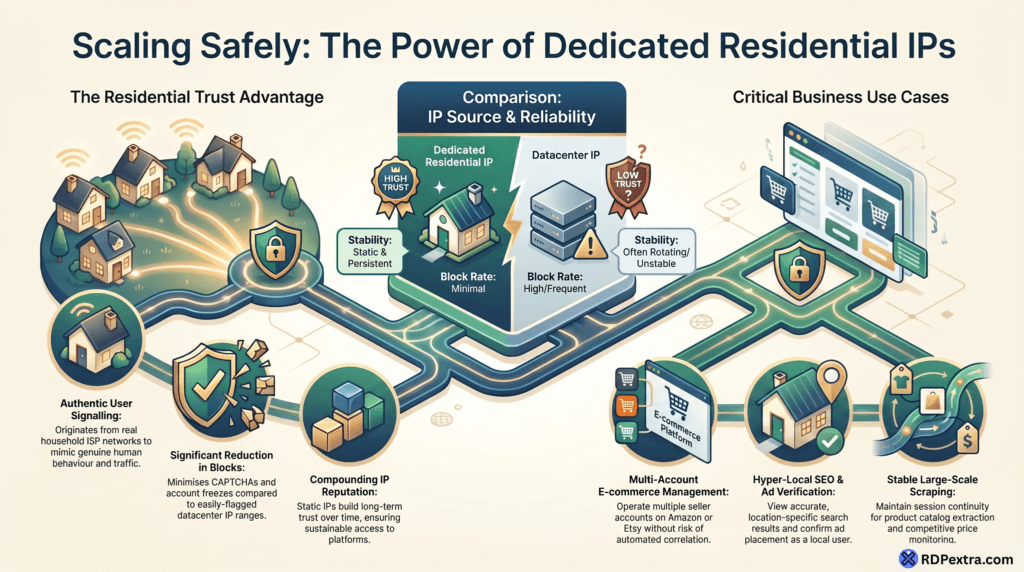
Dedicated Residential IPs for E-commerce and Market Research
E-commerce platforms now run smart fraud-detection systems that watch login behavior, IP reputation, location, and traffic patterns. A dedicated residential IP lets a business blend in with normal shopper traffic and pass those checks.
Managing Multiple Seller Accounts Safely
Running many seller accounts on platforms like Amazon, Walmart, Etsy, or Shopify is risky with shared or datacenter IPs. These often trigger systems that link accounts, which can lead to account reviews or permanent bans with little warning.
A dedicated residential IP per account gives you:
- one static residential IP per account, with no overlap between accounts
- stable login locations
- account trust that builds up over time
This directly lowers the risk of suspension and protects years of seller history and reviews.
Competitor Price Tracking Without Detection
Accurate competitor price data leads to better margin choices. But frequent price checks from non-residential IPs often bring fake prices, blocks, or shadow bans that quietly twist the data you collect.
A static residential IP lets businesses:
- track real competitor prices without setting off anti-scraping defenses
- view local storefronts accurately
- monitor regional promotions
- keep data access running over long collection periods
The result is clean, dependable market research, not data that detection systems have quietly bent after spotting odd traffic.
Fraud-Alert and Account Suspension Avoidance
Modern platforms weigh IP trust signals heavily when they screen for fraud. Residential IPs start with a better reputation and traffic that looks human, which cuts CAPTCHA loops, verification emails, and sudden account freezes by a lot.
SEO and Ad Verification With Location-Based Residential IP Access
SEO today is hyper-local, not global. Rankings, ads, and search intent differ by country, city, and sometimes neighborhood. Only residential IPs reliably show what real users in a place actually see.
Accurate SERP Tracking by Country and City
Residential-IP-based SEO checks support:
- location-based SERP tracking
- city-level keyword ranking audits
- local pack and map result checks
This removes the proxy bias that comes from checking rankings through datacenter IPs, which platforms increasingly route in a different way from real local traffic.
Geo-Specific Ad Verification for Google and Social Ads
Ad fraud and misplaced ads cost advertisers a lot of money every year. Ad checks through residential IPs let businesses:
- confirm ads show up in the right places
- check ads, language, and landing pages as a local user would see them
- spot unauthorized geo-targeting or cloaking
This matters across Google Ads, Meta Ads, TikTok Ads, and programmatic campaigns, anywhere location affects what you pay for.
Improving Local Search Accuracy for SEO Campaigns
Local SEO success depends on real user signals, not simulated traffic. Residential IPs let SEO teams test city-level rankings, audit competitor visibility by place, and check Google Business Profile presence based on what is really happening, not on guesses from a single national view.
Web Scraping and Data Mining With Stable Residential IPs
Scraping at scale depends on trust, steadiness, and continuity, three things datacenter IPs struggle to give once volume grows.
Large-Scale Data Collection With Consistent IPs
A stable residential IP supports long scraping sessions, product catalog extraction, pricing and market data gathering, and ongoing trend monitoring. Dedicated residential IPs usually do better than rotating proxies here, since they keep the session and the built-up reputation instead of starting from zero with every IP change.
Reduced Blocks, CAPTCHAs, and IP Bans
Anti-bot systems flag datacenter IP ranges almost at once. Residential IPs cut CAPTCHA challenges, short IP bans, and hard blacklisting by a good margin, which lowers costs and makes data collection more efficient.
Building Long-Term IP Reputation for Scraping
Reputation builds on itself. Steady, human-like behavior on a dedicated residential IP raises trust score, session life, and data quality over time, a real edge for any business that relies on nonstop scraping rather than one-off data pulls.
Choosing an ISP Source: What Actually Matters
Not all residential IPs are equal, and the ISP behind the IP matters more than most buyers know. Tier-1 U.S. ISP networks such as AT&T, Verizon, Comcast, or Spectrum usually give cleaner IP history, lower latency, higher uptime, and more real residential routing than smaller or lesser-known providers.
If you need an AT&T-sourced static residential IP, see our dedicated guide on AT&T residential RDP with static IP for details specific to that ISP. The tips in this guide apply no matter which Tier-1 ISP a provider uses.
When residential IP access comes with a full residential RDP setup, businesses get full desktop control along with the IP itself, which adds strong security and flexibility on top of the trust benefit.
High-Impact Use Cases Summary
- residential IP for e-commerce account management
- residential IP for market research
- dedicated residential IP for web scraping
- residential IP for managing multiple accounts
- location-based SERP tracking
- geo-specific ad verification
Each of these relies on the same three pillars: authenticity, compliance, and scalability.
How to Choose the Right Dedicated Residential IP Solution
Before you pick a provider, confirm they offer:
- real ISP-issued residential IPs that you can check with tools like ipinfo.io
- static IPs with no forced rotation
- a clean reputation history on the specific IP you get
- plans that scale as your accounts or campaigns grow
- 24/7 support, since IP issues are often time-sensitive
Solutions that pair a dedicated residential IP with a full residential RDP setup give a more complete package than the IP alone. See our residential RDP plans for a ready-to-use option.
According to Google’s Search Central documentation, search results and ad delivery change with user location and IP signals. That is exactly why location-accurate residential IPs matter for SEO and ad checks, not just account management.
Final Thoughts: Scale Without Limits or Bans
A residential IP for e-commerce & SEO tools is no longer optional. It is the base. From protecting seller accounts and checking ad placement to scraping data and tracking SERPs, residential IPs let businesses work safely, accurately, and at much larger scale than datacenter IPs allow.
Frequently Asked Questions
A dedicated residential IP is a static IP address given to one user only and taken from a real residential ISP network. Unlike shared or datacenter IPs, it looks like real home traffic, which makes it ideal for e-commerce account management, SEO checks, ad testing, and market research.
Residential IPs usually have higher trust because they come from real home internet connections. Many e-commerce platforms treat datacenter IPs as higher-risk traffic. A dedicated residential IP can help cut account reviews, verification challenges, and the risk of account limits.
A dedicated residential IP gives each seller account a stable and unique online identity. This cuts account overlap, lowers the risk of accounts being linked, and helps users run many stores on platforms such as Amazon, Walmart, Etsy, and Shopify more safely.
Yes. Residential IPs let SEO pros view search results the way real users in a given place see them. This gives more accurate local SERP tracking, competitor analysis, and geo-targeted SEO research than datacenter-based connections.
Residential IPs help advertisers check how ads look to real users in different places. They are useful for finding geo-targeting problems, ad placement errors, unauthorized changes to ads, and possible ad fraud across search engines and social media ad platforms.
