

Written by Team RDPextra - compiled from live keyword-demand data, a read of the current top-ranking Shared-vs-Admin RDP guides, and 20 verified primary sources (Microsoft, CISA, NIST, CIS, Gartner, IBM). Research compiled September 2026.
Shared RDP vs Admin RDP: Which One Do You Actually Need?
Remote Desktop Protocol (RDP) lets you connect to and control a Windows machine over the internet, using the built-in mstsc client that ships with every version of Windows.[1][12] The two ways providers sell that access, Shared RDP and Admin RDP, aren't just a price difference. They're a difference in what you're actually allowed to do on the machine once you're connected.
Get this choice wrong and you either overpay for control you never use, or you buy a cheap plan and discover two weeks in that you can't install the one piece of software your task depends on. This guide breaks down the real differences, when each one fits, and includes a 3-question picker at the end that gives you a direct answer.
What Is RDP, Quickly
RDP is Microsoft's protocol for remotely controlling a Windows session: your keyboard, mouse, and screen travel over the network to a machine that could be next to you or in a data center on another continent.[1] It runs on TCP port 3389 by default and has shipped in every Windows version since Windows XP.[12] What varies between providers isn't the protocol itself, it's what kind of account you get on the other end.
What Is Shared RDP?
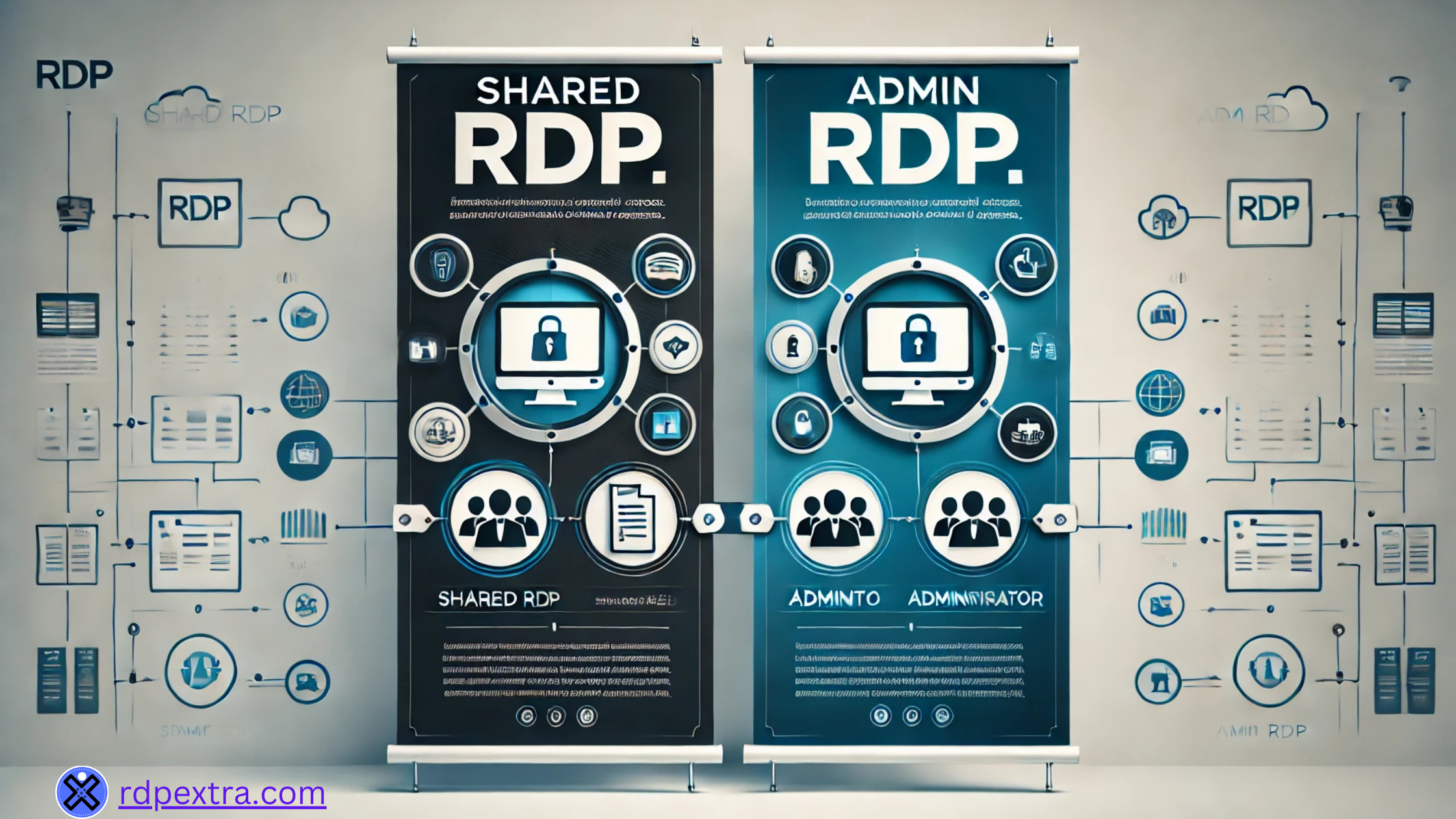
Shared RDP gives you a standard-user account on a server that other customers are also connected to. You get your own login and your own session, but CPU, RAM, and the underlying OS installation are shared, and you don't have rights to install software, change system settings, or manage other users.[6]
Shared RDP in practice:
- Standard-user permissions only. You can run whatever's already installed; you can't add to it.
- Resources fluctuate. A neighbor running something heavy can slow your session down.
- Cheapest way to get a real Windows session. The cost is split across every user on the box.
- Fits lightweight, single-app tasks - browsing, a pre-installed tool, basic file access - not anything that needs a new install.
What Is Admin RDP?
Admin RDP gives you an account with full administrator rights on the server: install and remove software, edit the registry, open firewall ports, create additional local users.[1][6] Depending on the provider, the underlying resources may still be shared or may be dedicated to you, but the access level itself is the defining feature, not the hardware.
Admin RDP in practice:
- Full administrator control - install anything compatible with the OS.
- You own the security configuration - firewall rules, encryption level, and Network Level Authentication (NLA) settings are yours to set.[2][15]
- You're also responsible for that configuration. Admin rights mean nobody else is locking the server down for you.
- Costs more - you're paying for capability, not just a session.
Shared RDP vs Admin RDP: Side by Side
| Feature | Shared RDP | Admin RDP |
|---|---|---|
| Account rights | Standard user | Full administrator |
| Install software | No | Yes |
| Resource allocation | Shared among multiple users | Often dedicated, provider-dependent |
| Security config control | Managed by the provider | Yours to configure and maintain[2][15] |
| Multi-user support | Single login per plan | Can add users, but each needs an RDS CAL beyond the built-in limit[4][5] |
| Best for | Browsing, pre-installed apps, basic tasks | Custom software, server management, dev/test environments |
Security: The Part Both Types Get Wrong If You Skip It
RDP is one of the most consistently abused entry points for ransomware and unauthorized access precisely because it's so widely exposed to the internet by default.[7][17][20] CISA's #StopRansomware guidance leads with limiting RDP exposure and applying best practices before anything else.[7] That applies whether you're on Shared or Admin RDP:
- Network Level Authentication (NLA) should be on. It authenticates you before a full session is even established, cutting off a common attack surface.[2]
- Encryption level matters. RDP supports multiple security layers and encryption levels under the hood; a reputable provider isn't running the weakest available setting.[3][15]
- On Admin RDP, you're the one who has to enforce this. Firewall rules restricting which IPs can even reach port 3389 are a standard hardening step you can set yourself with a couple of PowerShell commands.[19]
- On Shared RDP, ask the provider directly whether NLA and modern encryption are enforced - "cheap" describes price, not security posture.
The cost of getting this wrong is not abstract: IBM's Cost of a Data Breach research has repeatedly found remote-access-related breaches carry a higher-than-average cost, and NIST's enterprise telework guidance (SP 800-46) exists specifically because remote access is a disproportionately common way in.[8][10]
Need More Than One Person Connected? Read This First
Admin RDP is licensed per session host, not per unlimited user. If more than one named user needs to connect concurrently, Windows Server's Remote Desktop Services requires a Client Access License (CAL) for each one, tracked either per-user or per-device.[4][5] Trying to stretch a single-user Admin RDP plan across a team by sharing one login isn't just against most providers' terms, it also means you can't tell who actually did what on the server. A plan built for concurrent multi-user access, like RDPextra's Team RDP, exists specifically to avoid this.
RDPextra Plans at a Glance
Cheap RDP
Budget-pricedSingle userStandard-user access for basic, single-session tasks without admin requirements. View Cheap RDP →
Admin RDP
Full admin rights ✓Install anythingFull administrator control to install software, change settings, and manage the server as your own. View Admin RDP →
Team RDP
Multi-userAdmin rights ✓Concurrent multi-user access with admin rights, built for teams instead of one shared login. View Team RDP →
Get a Recommendation in 3 Taps
Reset answers
FAQ
What's the actual difference between Shared RDP and Admin RDP?
Account rights. Shared RDP gives you a standard-user login on a server other people also use. Admin RDP gives you full administrator control, whether or not the underlying hardware is shared.
Is Shared RDP secure enough for business use?
It can be, if the provider enforces Network Level Authentication and modern encryption.[2][15] Ask directly rather than assuming - price doesn't tell you the security configuration.
Can I install my own software on Shared RDP?
No. Standard-user accounts can run what's already installed but can't add new software - that's the defining limit of Shared RDP, not a bug.
Do I need Admin RDP for basic browsing or a single pre-installed app?
No. If you're only using software that's already there, Shared RDP covers it and Admin RDP would be paying for rights you won't use.
Can multiple people share one Admin RDP login?
Not without a proper multi-user license. RDS requires a CAL per concurrent named user beyond the built-in limit[4][5] - a plan built for teams, like Team RDP, is the correct fit instead.
Can I upgrade from Shared RDP to Admin RDP later?
With most providers, yes - confirm the migration path before buying the cheaper plan if you think you'll need admin rights soon.
References
- Microsoft Learn - Welcome to Remote Desktop Services
- Microsoft Learn - Enable Remote Desktop on your PC (Network Level Authentication)
- Microsoft Learn - Understanding the Remote Desktop Protocol
- Microsoft Learn - License RDS with Client Access Licenses (CALs)
- Microsoft Learn - Install Remote Desktop Services CALs
- Microsoft Learn - Add a User to Services RDP Permissions
- CISA - #StopRansomware Guide
- NIST SP 800-46 Rev. 2 - Guide to Enterprise Telework, Remote Access, and BYOD Security
- NIST SP 800-63B - Digital Identity Guidelines: Authentication
- IBM - Cost of a Data Breach Report
- Gartner - Worldwide Public Cloud Spending Forecast
- Microsoft Learn - Remote Desktop Protocol (Win32 reference)
- Microsoft Learn - Remote Desktop Services in Azure
- OWASP - Cheat Sheet Series
- Microsoft - [MS-RDPBCGR] Standard RDP Security Specification
- Microsoft Learn - Windows Server 2022 Editions Comparison
- CISA - Advisory AA20-073A: Enterprise VPN and Remote Access Security
- Microsoft Learn - mstsc Command Reference
- Microsoft Learn - Manage Windows Firewall with the Command Line
- CIS - Commonly Exploited Protocols: Remote Desktop Protocol (RDP)
[…] to know what is RDP and how remote desktop works.If you’re comparing options, here’s the full difference between shared RDP and admin RDP explained clearly.You can also read our ultimate guide to private RDP if you want deeper details […]